Map pack invisibility
Not in the three businesses Google shows on the map
People search for your service in your town and three competitors appear on the map. You're further down, below the fold, where nobody taps.
For a service business, the map pack is the shop window. Winning it takes four things moving together: a Google Business Profile filled in completely and consistently, your name, address and phone matching everywhere they appear, a steady flow of real reviews, and location pages that tie your service to each place you serve. Your service and your town have to be connected on every one of those surfaces. If your homepage talks about the service and forgets the town, the map pack has no reason to rank you there.
If a competitor with worse reviews keeps showing above you on the map, this is why, and it's fixable.
Not in the three businesses Google shows on the map
People search for your service in your town and three competitors appear on the map. You're further down, below the fold, where nobody taps.
Your name, address and phone differ across the web
Your old address is still on three directories, your phone number is formatted four ways, and Google isn't sure which version of you is real.
Too few recent reviews to be trusted
You do great work but only ask for reviews when you remember. A competitor with a system has three times as many, and newer.
Each part below is a real piece of the work, with the trade term it goes by and what it means in plain English.
Your listing on Google Maps, filled in properly
Every field populated, not just the required ones. The description starts from a set of plain facts about your business, so every platform tells the same story. Services, products and service areas set up, with posts on a calendar and each post linking to the right page.
Your business details on every directory, matching
A consistency audit across your existing listings, then a gap analysis of the citations your competitors have that you don't. Missing profiles on Bing, Apple Maps and the directories that matter in your vertical get set up.
A steady, honest flow of new reviews
Not a one-off “please review us” blast. Emails collected at the right moments, personalised requests that name the technician who did the job, the review link in every email signature, and a postcard with a QR code for trades where a physical touch works better.
A real page for each place you serve
Location pages built from a template that's actually useful per area, with local signals in the schema and links to the matching service pages. Duplicate city pages competing with each other get merged, because split pages are one of the most common reasons local rankings stall.
Local rankings are an entity problem
Your business has at least two things Google needs to connect: what you do, and where you do it. If they only appear together on one page, the map pack sees a weak link. I make them travel together in your profile, your citations, your schema, your location pages and your reviews.
Your profile against the businesses beating you on the map.
One source of truth for your details, used on every platform.
Sources to fix and sources to add, tracked to live.
Emails, links, QR material and reply templates.
Template plus pages for each area you serve.
Competitor profiles analysed and your listings checked for consistency.
Google profile optimised, missing profiles created, citation work started.
Area pages and local schema pushed live, linked to your services.
Review requests, profile posts and ranking checks every month.
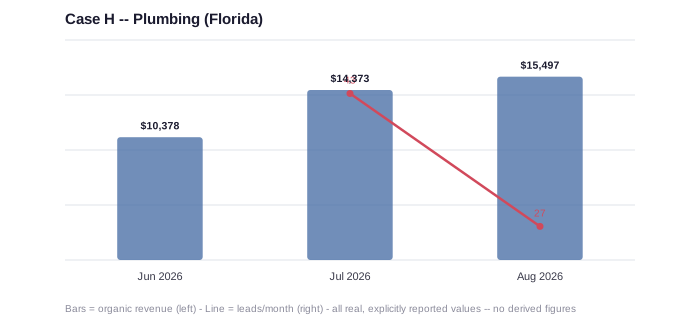
Organic revenue for a local plumbing business grew three months in a row, from $10,378 to $14,373 to $15,497, reported in actual dollars, not percentages.
The honest part: Lead volume wasn't a straight line: 43 leads in July fell to 27 in August, even as revenue and booking rate improved that month.
The same service does a different job in each trade. Here is the move it makes in each industry I've written up.
SEO has its own vocabulary. Here's the part of it this service uses, so a report never reads like a foreign language.

Everything on this page comes from how I actually run this work. The checklists, the tools and the results are real. Tell me what's happening on your site and I'll tell you honestly whether this is the right place to start, or whether something else needs fixing before it.
Yes. Service-area businesses can hide their address and list the areas they cover instead. The profile, citations and location pages still do the same work.
I build the system that asks at the right moments. You still earn the reviews. Fake or bought reviews put your whole profile at risk, and I won't do that.
Only if each page can say something real about that area. Near-identical city pages end up competing with each other, which is a common reason local rankings stall. I'll tell you which areas justify their own page.
Links and mentions from sites that are growing, relevant and trusted in your market, qualified before a single one is bought or pitched.
See the service Get foundTitles, headings, answers, schema and links reworked page by page, so Google understands each page and buyers act on it.
See the service Get foundA map of every page your site needs to own its subject: what to build, in what order, and how each page links to the one that makes money.
See the serviceSend me your site and what you're trying to grow. I'll look at it myself and reply personally, usually within one business day.