Thin content
Pages that say little that isn't said everywhere else
You've published a hundred posts. Most of them rephrase what's already on page one. Google has no reason to prefer yours, and neither does a reader.
Most SEO content is written to hit a word count. Mine is written to do one job per page: a service page sells a decision, a guide answers a question well enough to be quoted, a product page gets someone to the cart. Each page starts from the topical map and an outline, is written against a set of rules for its page type, passes a banned-words check, and is reviewed against the same checklist it was written from before it goes live.
If your content is long, polished and not bringing in customers, the problem is usually the job, not the words.
Pages that say little that isn't said everywhere else
You've published a hundred posts. Most of them rephrase what's already on page one. Google has no reason to prefer yours, and neither does a reader.
Service pages written like encyclopedia entries
Your service page explains what the service is for six paragraphs, then says “contact us” once at the bottom. The buyer wanted to know why you, and what happens next.
AI tools answer your customers' questions without you
Ask an AI assistant a question in your field and it names three competitors. Your site answers the same question, just not in a shape it can lift.
Each part below is a real piece of the work, with the trade term it goes by and what it means in plain English.
Pages whose job is to win the enquiry
Written to your own commercial rules: start by identifying the main entities, anchor every section to the service, use commercial language where the buyer is weighing up and direct, transactional language where they're ready to act. The opening paragraph summarises the page and hands straight off to the next step.
Writing the passage AI answers will quote
AI answers don't read your whole page, they extract short passages, and they lean heavily on the top of the page. Each section answers its heading in its opening sentence or two, names the thing it's about, and backs every claim with a source, a credential or a real example.
Guides and articles that support the money pages
Every guide exists because the topical map says it should, links to the page that makes money, and covers the main question plus the follow-ups a reader has next, without drifting into topics that don't belong.
Improving or removing what you already have
Existing posts are kept, merged, rewritten or removed. Cutting thin content can shrink total clicks for a while while the pages that sell grow. That trade-off is shown in your report, not hidden.
A designed pipeline, not one-off prompts
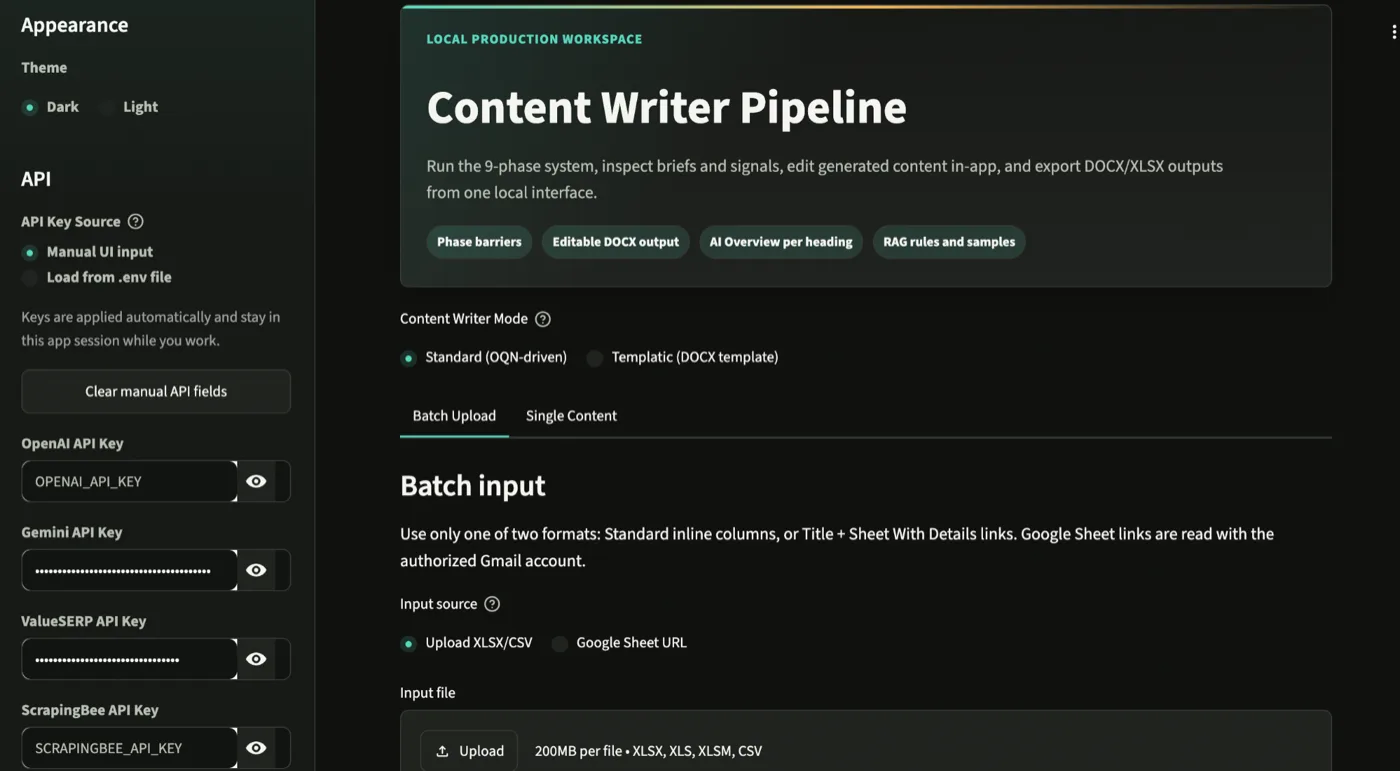
Pages move through fixed stages, each with its own tool and its own checklist. It's why the hundredth page reads as carefully as page one, and why it can't quietly drift into generic filler.
Which pages to write, rewrite, merge or remove, in order.
For every page, before writing starts.
Written, linked and reviewed, ready to publish.
Your existing pages with a decision on each.
Pages chosen from the topical map, existing content inventoried.
Structure, entities and sources fixed before a word is written.
Written to the rules for the page type, then linked by context.
Checked against the same checklist, then published and tracked.
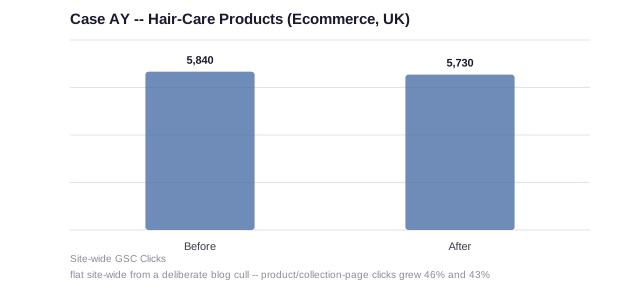
Thin blog content was cut from over 190 posts to under 80. Over the next three months, clicks to the pages that sell grew: product pages up 46%, collection pages up 43%.
The honest part: Site-wide clicks were essentially flat (5.84K to 5.73K) because of the deliberate cull. That trade-off is the honest shape of this result.
The same service does a different job in each trade. Here is the move it makes in each industry I've written up.
SEO has its own vocabulary. Here's the part of it this service uses, so a report never reads like a foreign language.

Everything on this page comes from how I actually run this work. The checklists, the tools and the results are real. Tell me what's happening on your site and I'll tell you honestly whether this is the right place to start, or whether something else needs fixing before it.
AI does part of the drafting inside a pipeline I designed, with a knowledge pack, fixed rules per page type and a banned-word pass. Every page is outlined, briefed and reviewed against a checklist. It isn't one prompt and publish.
Yes. The brief carries your voice, the terms you use and the ones you don't. Service pages especially need to sound like you, not like an agency.
Total clicks can dip for a while. What should grow is traffic to the pages that make money, and your report shows both, so you can see the trade.
A map of every page your site needs to own its subject: what to build, in what order, and how each page links to the one that makes money.
See the service Get foundTitles, headings, answers, schema and links reworked page by page, so Google understands each page and buyers act on it.
See the service SpecialistPlugins, scripts and AI apps that take the repetitive SEO work off your team: bulk fixes, reporting, audits and content pipelines.
See the serviceSend me your site and what you're trying to grow. I'll look at it myself and reply personally, usually within one business day.