Redirect loss
Old pages forwarding nowhere, or to the wrong place
Every old URL was sent to the new homepage. Google treats that as the pages disappearing, and the rankings go with them.
Migrations are where years of rankings get lost in a weekend. A redesign ships with the staging site's noindex tag still on. A rebrand redirects every old page to the new homepage. A platform move quietly drops half the tracking. I run migrations as gated phases: record everything you currently rank for, map every old URL to its true new equivalent, move in stages with a monitoring window between each, and verify tracking, schema and redirects before calling it done.
If a redesign, rebrand or platform move is on the calendar, bring me in before the developers start, not after traffic drops.
Old pages forwarding nowhere, or to the wrong place
Every old URL was sent to the new homepage. Google treats that as the pages disappearing, and the rankings go with them.
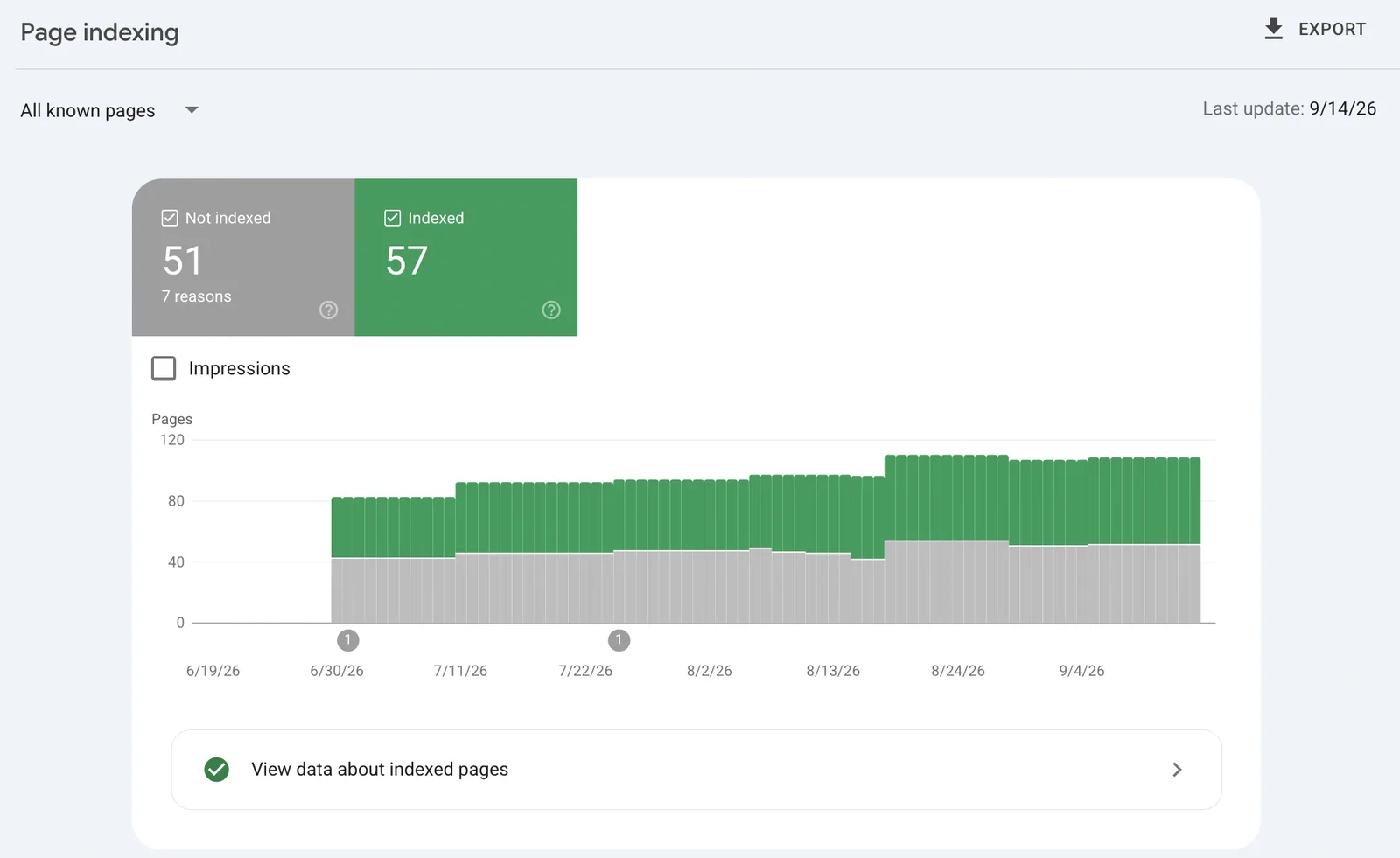
The new site told Google not to show it
The staging site was blocked from Google, correctly. Then it went live with the block still on. It's the single most common redesign failure.
Analytics and conversions silently stop recording
Traffic looks like it collapsed after launch. Some of it did; the rest is a tag that never made it onto the new templates. Now you can't tell which is which.
Each part below is a real piece of the work, with the trade term it goes by and what it means in plain English.
Recording everything you have before anything changes
A complete backup, then the facts that prove later whether the move worked: your high-value pages, backlink profile, how many keywords rank in the top 10, top 3 and at number 1, and your robots, htaccess and llms.txt files so the same rules move with you.
Matching every old URL to its true new equivalent
Every old URL mapped to the page that genuinely replaces it, not to the homepage. The map is the shared sheet between your developers and me, and the final redirects are written as server rules.
Moving in stages instead of all at once
Phase one sets canonical tags and a notice on the old domain, then waits ten to twelve days. Phase two flips the canonicals, then waits again. Only then do the full redirects go in, followed by Search Console's change-of-address and a DNS update.
Four checkpoints a redesign can't skip
The live site is copied to staging and tallied against it before work starts. Every button, form and menu is tested before launch. Orders and form entries made during the build are carried over. After launch, the noindex block is checked for removal, caches cleared and the sitemap resubmitted.
Changing names or merging sites without losing either
When a brand changes name or one business absorbs another, both domains are crawled, the equivalent pages mapped, About pages on both sites updated, and the change announced on social profiles and through PR so customers and Google both follow.
Never start a migration on a Thursday or Friday
It's stamped on every phase of every migration checklist. Push a change late in the week and any breakage (crawl errors, lost tracking, broken forms) runs through the weekend with nobody watching, right when Google is most likely to re-crawl. Monday to Wednesday means a full week of monitoring and same-day fixes.
The phases, owners and go-live days, agreed before work starts.
Rankings, traffic, backlinks and pages captured before the move.
Every old URL against its new equivalent.
Gated checks for each phase, signed off in order.
Redirects, tracking, schema and a full crawl of the new site.
Backups, ranking snapshots, the old site crawled and every URL mapped.
Canonical tags and notices set, then 10–12 days of monitoring.
Canonicals flipped, another monitoring window, then full redirects and change of address.
Tracking, schema and redirects verified, then weekly monitoring while the dip recovers.
A large YMYL medical site rebuilt while it held the number-one position for a 135,000-a-month search term, and number one for a second term searched 90,500 times a month. Nearly 3,900 URLs were audited and 20,000 low-value pages cleared out along the way.
The honest part: This is a large, ongoing engagement, not a finished one. Indexing across the wider site is still being worked on, and Core Web Vitals remain a known weak spot.
The same service does a different job in each trade. Here is the move it makes in each industry I've written up.
SEO has its own vocabulary. Here's the part of it this service uses, so a report never reads like a foreign language.

Everything on this page comes from how I actually run this work. The checklists, the tools and the results are real. Tell me what's happening on your site and I'll tell you honestly whether this is the right place to start, or whether something else needs fixing before it.
Expect a temporary dip, typically 10–30%, with recovery over weeks to months. The goal of the process is to keep that dip small and short, and to be able to prove where any loss came from.
You can, but I'd advise against it. Moving like-for-like before any redesign means that if something drops, you know which change caused it.
Before the designers and developers start. The redirect map, baseline and gates have to be planned into the project, not added the week before launch.
Crawl, index, render and speed problems found, evidenced and fixed on the live site, then re-checked until they're gone.
See the service Fix the foundationFind out what actually caused the drop, fix the cause instead of the symptoms, and track the recovery week by week.
See the service Build authorityYour Google Business Profile, citations, reviews and location pages built to win the map pack in the places you actually serve.
See the serviceSend me your site and what you're trying to grow. I'll look at it myself and reply personally, usually within one business day.