Core or helpful content update hit
Traffic fell right after a Google update
Rankings dropped across the whole site overnight, not just a few pages. Nothing changed on your side, and nobody can say what Google didn't like.
When traffic falls off a cliff, the gut instinct is to change everything at once. That destroys the evidence. I start by lining the drop up against Google's update timeline and your own change history, then check whether it's a site-wide trust problem or a handful of pages. Recovery work runs in a fixed order: prune what shouldn't exist, strengthen who's behind the content, then repair structure. Every week is measured, so you can see whether it's working rather than hoping.
If you lost traffic and three people have given you three different theories, start with the diagnosis.
Traffic fell right after a Google update
Rankings dropped across the whole site overnight, not just a few pages. Nothing changed on your side, and nobody can say what Google didn't like.
Google judging the whole site, not one page
Even your best pages slid. That's the sign of a site-level judgement: a few weak sections dragging down everything else.
A slow slide with no clear trigger
No dramatic drop, just fewer clicks every month. It could be competitors, duplicates splitting your pages, tracking breaking, or all three.
Each part below is a real piece of the work, with the trade term it goes by and what it means in plain English.
Finding the real cause before touching anything
The drop is matched against Google's update dates, your deployment history and Search Console by page and query. Tracking gets checked too, because a broken analytics tag can look exactly like a traffic collapse.
Removing or merging pages that drag the site down
Thin pages, near-duplicates and affiliate-only pages with no unique value get removed, noindexed or merged into stronger pages. Narrow and deep recovers faster than wide and shallow.
Showing who's behind the content, and why to trust them
Named authors with linked bios and real credentials, revision dates on older articles, and new, clearly non-commercial content in your core topic. Anonymous or ghost-written “expert” bylines get replaced.
Checking what the last SEO actually did
Before writing a new plan, I test the previous one. What was promised, what was done, what was never implemented, and what might have caused the drop. That includes my own past work, if I was the last SEO.
Quality updates act like a multiplier on your whole site
A technically sound site still collapses when a site-wide quality judgement multiplies everything else. That's why recovery runs in a fixed order. Sites that never recovered in my portfolio were the ones where the business model itself was too thin to fix cosmetically, and I'll tell you if that's the case.
The cause, with the evidence for it and the theories ruled out.
Every weak page and what happens to it.
One ordered plan, not a list of possibilities.
Search Console against the pre-drop baseline.
Cause found and evidenced before any change is made.
Thin, duplicate and valueless pages removed or merged.
Authors, credentials, revision dates and core-topic content.
Schema, internal links and sitemap, then weekly measurement.
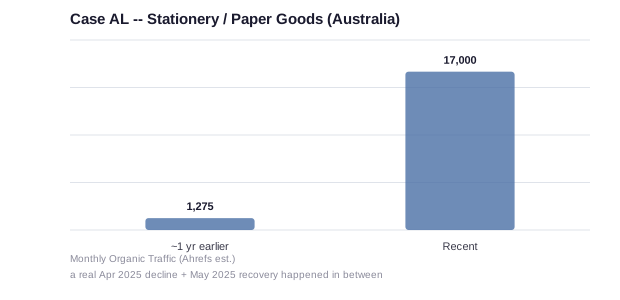
A real double-digit fall in users, clicks and sales in April 2025, back to the previous level by May. A later report shows the store at around 17,000 monthly organic visits, against roughly 1,100–1,450 a year earlier.
The honest part: These are two snapshots about a year apart, and the later report is undated. The exact shape of the trend between them isn't documented.
The same service does a different job in each trade. Here is the move it makes in each industry I've written up.
SEO has its own vocabulary. Here's the part of it this service uses, so a report never reads like a foreign language.

Everything on this page comes from how I actually run this work. The checklists, the tools and the results are real. Tell me what's happening on your site and I'll tell you honestly whether this is the right place to start, or whether something else needs fixing before it.
On the sites I've recovered, partial recovery showed up in weeks two to four and full recovery in weeks six to ten. Sites where the underlying model was too thin didn't recover at all, which is why the diagnosis comes before any fix.
No. If the drop is a judgement on a business model that's thin at its core (pages built only to catch clicks), cosmetic fixes won't hold. I'll tell you that plainly rather than sell you a recovery that can't happen.
Only the ones the diagnosis says are dragging the site down, and often merging is better than deleting. Mass deletion without a diagnosis can make things worse.
Crawl, index, render and speed problems found, evidenced and fixed on the live site, then re-checked until they're gone.
See the service Get foundService pages that sell, guides that get quoted in AI answers, and a rule book that keeps every page on-brand and free of filler.
See the service Get foundA map of every page your site needs to own its subject: what to build, in what order, and how each page links to the one that makes money.
See the serviceSend me your site and what you're trying to grow. I'll look at it myself and reply personally, usually within one business day.